

Ostrich Solution
by Darrin Barker June 10, 2015
In the fall of 1987 I began my freshman year in the University of Wisconsin system. The first assignment in my College Writing 102 class was to author an essay about personal experiences with racism. This first project was to be accompanied by hours of lecture hall conversation about prejudice and intolerance – which I soon discovered were my professor’s very favorite subjects to discuss. She repeatedly stressed the importance of examining bigotry and discrimination . . . suggesting it were typically a taboo subject among the bulk of our society.
I had observed the topic of racism receiving extensive coverage throughout the 1980’s. National publications like Time and Newsweek often focused on racial discrimination in America. Accompanying each story were polls and statistics supporting claims of bias. Primetime TV news magazines also frequently highlighted race issues. Then we had the subject of bigotry in movies, television dramas, after school specials, daytime talk shows, and award winning sitcoms. If any specific situation comedy desired recognition the simple route were to produce one issue orientated episode focusing on racism. Public education certainly had not skipped over our founding fathers’ worst sin. Throughout my high school years the subject of racism had been thoroughly examined during various classes. I had been taught the history of racism from slavery to ‘White Only’ signs and every lynching in-between. Repeatedly each lesson was teamed with discussion about current day racial inequities. Taboo? What planet had she been living on?

As a college freshman I knew little about political ideology and could have cared less which my professor identified with. What I did have a solid grasp on was my wallet – and the cost per credit of tuition. Writing about skin color I found intellectually insulting and perhaps a waste of my hard earned tuition. I presumed most of my classmates would agree. After all, this classroom was filled with young adults who had academically excelled throughout high school. The bulk of us had just endured a dozen grueling years of completing remedial assignments targeting below average students often restraining our potential and resulting in complete boredom. Despite the frequent redundancy and simplicity of public education we continued meeting every obligation fully aware jumping through all of the hoops were required to later attend an accredited university. Now after we have finally attained university echelon our first assignment is to orate the trivial notion humans come in different colors? I believe we had all covered this subject in a much earlier course . . . somewhere between finger painting and nap time. Is this really what ‘higher’ education is all about? By the way, in Kindergarten we also learned that people span a variety sizes . . . will that be on the midterm?
Reluctantly, I put together an essay offering honest opinions, observations, and a slight tint of humor just to wake my audience. When the class met again my professor asked students one by one to recite their paper to the class – each reading was followed by input and discussion. The boredom I had expected instead developed into passionate conversation.
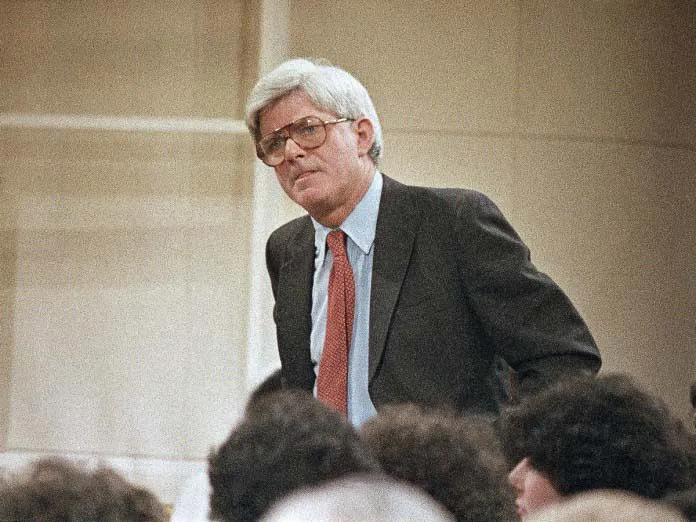
She first concentrated on my black classmates. I recall several stories about racial profiling by store clerks, cabbies, and law enforcement. As each student aired their grievances my professor would aim her eyes downward and shake her head in disgust – a perfect imitation of Phil Donahue. Then she would apologize on behalf of white America while lumping herself in with the guilty. Apparently condemning oneself bestows authority to sit in judgement of your entire ethnic subset. I must have missed the meeting implementing this new directive.
After a handful of such examples she began scanning the room soliciting any volunteer to read. Listening to the next set of essays I soon realized that students had searched deep within their psyche to find – what I viewed as – very trivial feelings and circumstances then interpreting them as bigotry. Instead of questioning our professor’s assumption that all whites were racist – instead of rejecting her ability to characterize all Caucasians – my white classmates appeared to confirm her supposition. They told stories about crossing the street to avoid a group of black males, feeling nervous while driving through a predominantly black neighborhood, and the ultimate sin - using terms like ‘they’ or ‘them’. Following each admission my professor commended the writer for boldly sharing his or her deep-seated racism.
While my eager peers lined up to throw themselves overboard the defiance inside of me began to grow. Even those who were not falling on the sword made simplistic and cliché comments such as, "It is almost 1990 and I think it is terrible that racism still exists. Why can't we just treat everyone with the same respect whether they are white, black, or purple?” The lecture hall would then erupt in applause while the professor commended us all for our tolerance and enlightenment. I had not yet formulated my views on purple human beings so I abstained from the applause and euphoria.
The constraint of our class time gave me a two-day reprieve – which I used to re-think my entire paper. My original essay had focused on all of the major improvements the United States had made during the course of my parents’ generation. In a mere three decades, when it comes to education and employment, blacks had gone from the back of the bus to the front of the line. “White Only” signs turned into “Minorities Preferred” job listings. Refusing a bank loan, job opportunity, or college admission based on race was not only socially unacceptable but punishable by law. Bigots will never completely disappear. However, like Bell Bottom corduroy pants no self-respecting individual dare be seen near them again. Freedom and liberty had finally prevailed for all Americans. I saw a time to celebrate progress rather than dwell on repulsive actions by generations before.
I went on to applaud my parents’ handling of the race issue . . . or should I say . . . their non-handling of the issue. You see, in our household we simply ignored ethnicity. I was taught to respect adults – and given no exemptions for skin tone. The expectation of always treating others politely and respectfully had no ‘whites only’ disclaimer attached. This simply left no reason to discuss ‘racial issues’. Even if I had developed some bizarre loathing for a specific skin tone my feelings – as I was taught - would always take a back seat to appropriate behavior. In our home there was no debating your way out of trouble or talking a job done. Conduct was always on the final exam.
Yet in this freshman classroom I listened to my peers’ nit-picking trivial events. Unrealistically, I saw young African-Americans expecting universal respect. Trust me, we all feel ‘dissed’ at times. Ever been to the DMV? The assumption that every instance of ‘disrespect’ had something to do with skin color simply cannot hold true. “Sticks and stones” applies here in most cases. Some people are just assholes – whether it is personal, racism, or too much decaf they are simply unpleasant. Comparing dirty looks from a department store clerk to state sponsored discrimination is an insult to Rosa Parks, Martin Luther King Jr., and the entire civil rights movement of the 1960’s. They had to fight for equal application of constitutional rights – not for quicker service at Dennys.

I found it perplexing that so many of my exceedingly open minded Caucasian classmates felt such a need to apologize when they had discriminated against no one. It did not take long until I realized what I were observing was selfishness and not empathy. Admissions of guilt were little more than narcissistic complement fishing. Each apology for some fleeting moment of irrational discomfort would result in praise from our professor and forgiving words from classmates. The attempt to elicit praise was every bit as obvious as a supermodel claiming, “I look so fat!”.
My observations evaluated this entire exercise as more damaging to race relations than helpful. Surrendering to the emotional side of racism swerves off the genuine road toward equal civil rights. Blurring the lines between passing feelings and discriminatory actions steers dangerously close to the concept of federal thought police. I felt so strongly about the misdirection of our assignment that I replaced my essay with a short paragraph sharing my personal analysis. When my turn arrived I said this:
"After three full hours of listening to this discussion I still find myself in disagreement with the premise. Our American society is not ignoring the issue of race. Rather, it seems we are constantly talking about it. I am not questioning whether racism is real . . . I still see it all over our American society. But if we are going to have a real discussion about racial inequities we need to distinguish between racist thoughts and racist actions. We have laws on the book to deal with those who perform discriminatory acts or business practices. As for those who hold racist thoughts and feelings? No amount of intelligent dialogue will reach the truly oblivious. Ignorance is their own sentence. Therefore, perpetually arguing racial issues I find counterproductive. The greatest step toward ending discrimination may be to STOP discussing the issue. So let me be the first to volunteer - as I have no particular feelings about skin color to share."
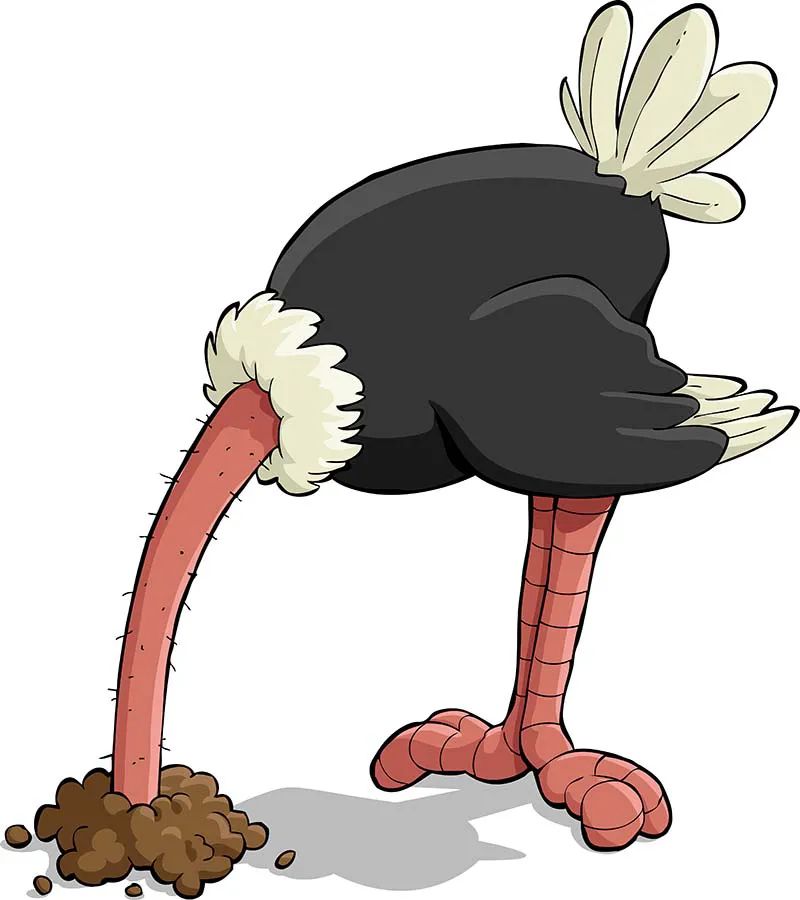
My words were not followed by the applause I had imagined. Suppressed laughter was the only reaction I recall. My professor rang in with a scolding voice, "We need to all be serious about this discussion." Apparently my teacher had not even considered the possibility I was serious. “Closed-minded indifference is the root of all racism and should not be tolerated by any advanced culture.” She added – and then quickly moved on to the next few comments. At this point my classmates – wisely reinforcing the individual scoring their essays – piled on while labeling my suggestion the ‘Ostrich’ solution.
I would like to finish this story by reciting the shrewd and perceptive words I interwove to cleverly paint my professor into an imaginary corner – but I cannot. I would like to describe how I enlightened my classmates to the difference between racist thoughts and bigoted actions – but that would be bogus as well. The truth is I remained silent and inconspicuous the remainder of the semester while cross-examining my own assessments.
Social pressures had obstructed me from detecting the glaringly obvious absurdity of my professor’s argument. Indifference about skin color is the root of all racism? Right. And abstinence causes teenage pregnancy. Oh, only if I could travel back to that moment today.
Today I have decades of proof on my side. Between 1957 and 1987 astonishing progress was made due to extremely brave individuals dedicated to improving the human condition. Then white liberals took over and led the civil rights movement down an ill lit dead end alley. Almost three decades later every complaint about 1987 society remains. The truly colorblind – individuals like myself – are blamed for racism while white liberal self-appointed civil rights leaders like my former professor go on obsessing over our differences. If they would have listened to my college Freshman counterpart three decades ago our society would be in a much better place today.